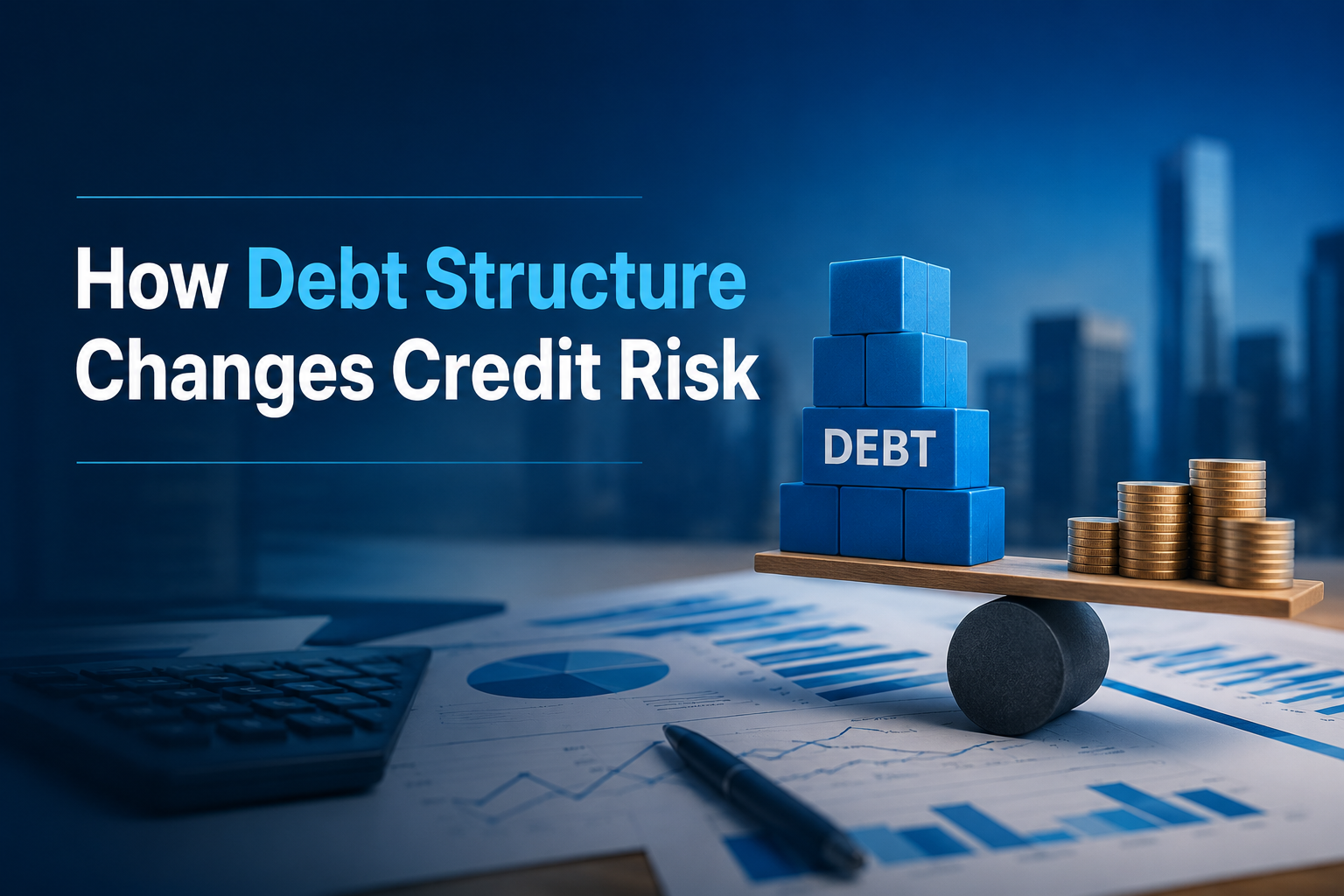
This is why credit rating agencies do not look at how much debt a company has. They also look at how the debt is structured, when it needs to be repaid, what it costs, and whether the company has enough cash flow to manage it.
Understanding this relationship is important for businesses and investors. ICRA Uganda considers different financial and business factors while assessing creditworthiness.
What Is Debt Structure?
Debt structure refers to the different types of borrowing a company has and the terms respectively involved in it.
A business may have:
Short term loans
Long term loans
Bonds
Working capital facilities
Overdrafts
Foreign currency debt
Fixed rate
Each type of borrowing creates different risks.
For example, a company that has mostly long-term debt may have more time to repay its obligations. Another company with a large amount of short-term debt may need to arrange new financing more frequently.
Therefore, two companies with the same total debt can have very different levels of credit risk.
Why Short-Term Debt Can Increase Risk
Short-term debt usually needs to be repaid within a short period of time.
If the company has a large amount of short-term debt, it needs to maintain enough cash to access financing to meet the upcoming repayments.
This can become a problem if cash flow falls unexpectedly.
For example, a company may be profitable but still face financial pressure if several large loans become due at the same time.
This is why the timing of repayments is an important part of credit analysis.
The Importance of Long-Term Debt
Long-term borrowing gives a company more time to repay its debt. This can make financial planning easier, particularly when the borrowed money is used for projects that are expected to generate income over several years.
However, long term debt does not mean it has a low level of risk.
A company with very high long-term debt may still face an increment in the interest costs and may have limited financial flexibility.
The main question is whether the company’s cash flow is strong enough to manage the debt over time.
Interest Rates Also Matter
The cost of borrowing directly affects a company's financial position. A company with variable-rate debt may see an increase in the interest costs when the market interest also rises.
This can reduce the amount of cash available for operations, investment, and debt repayments.
Fixed-rate debt provides more certainty because the interest cost generally stays stable for the agreed period of time.
Credit analysis looks at the company’s obligations for interest and how changes in financing costs could affect its ability to manage the debt.
Foreign Currency Debt Can Create Additional Risk
Businesses that borrow in a foreign currency can face another type of risk also.
If a company earns most of its revenue in one currency but has debt in another, then changes in exchange rates can increase the cost of servicing that debt.
For example, if the local currency loses value against the currency in which the debt was borrowed, the company’s repayment burden may increase.
Debt Structure and Cash Flow
A company may have strong revenue but still experience cash flow problems. This can happen when customers take a long time to pay, operating costs increase, or large amounts of money are tied up in inventory.
A well-structured debt profile should match the company’s ability to generate cash.
When repayment schedules and cash flows are properly aligned, the company may have good financial flexibility.
How Debt Structure Can Affect Credit Ratings
Credit rating agencies consider debt structure as part of a wider credit assessment.
They may examine:
Total debt
Short-term and long-term debt
Interest costs
Repayment schedules
Cash flow
Foreign currency exposure
Access to additional financing
Overall financial flexibility
A company with manageable debt, stable cash flow, and well-planned repayment schedule may present lower credit risk.
On the other hand, high debt combined with weak cash flow, large short-term repayments, or significant foreign currency exposure may increase financial risk.
However, debt structure alone does not determine a credit rating. Other factors, including business performance, industry conditions, management, governance, and future outlook, are also considered.
Conclusion
Debt is not necessarily a problem for a business. In fact, well-managed borrowing can support expansion and overall growth. A company who is good at managing its debt structure, cash flow, and has controlled interest costs are better at managing their financial obligations. On the other hand a company who is poor at all these can create pressure even when a business appears profitable.
This is why understanding debt structure is a very important part of understanding the credit risk. Through independent assessments, ICRA Uganda helps in providing a clear view of the factors that can influence a company’s overall credit profile.